
Asset Management
The City of Temiskaming Shores manages a wide range of infrastructure assets that support essential municipal services. Asset management provides a structured approach to planning, operating, maintaining, renewing, and replacing these assets to ensure reliable service delivery, responsible financial planning, and long-term sustainability for the community.
About Asset Management
Asset management is the coordinated planning, operation, maintenance, renewal, replacement, and disposal of infrastructure assets to provide the best possible service to the community at the lowest long-term cost, while balancing risk, service levels, and available financial resources. This approach ensures municipal infrastructure continues to support community needs while maintaining safe and reliable service delivery.
Asset Management Policy
On December 17, 2017, the Province of Ontario approved Ontario Regulation 588/17 under the Infrastructure for Jobs and Prosperity Act, 2015, establishing new requirements for municipal asset management planning. The regulation introduced phased timelines for the preparation of updated Asset Management Plans.
Under the regulation, July 1, 2019 was established as the deadline for all municipal governments to finalize an initial strategic asset management policy, obtain Council approval, and make the policy available for public viewing. Section 3 of the regulation outlines 12 required policy matters and requires the policy to be reviewed every five years.
On January 15, 2019, Council received Administrative Report PW-001-2019, outlining the requirements of Ontario Regulation 588/17, and re-committed to asset management by directing staff to initiate development of an updated Strategic Asset Management Policy. On April 16, 2019, Council received the draft policy for first and second reading of By-law 2019-063, being a by-law to adopt an Asset Management Policy for the City of Temiskaming Shores, and directed staff to circulate the policy for comment. On May 21, 2019, the by-law received third and final reading.
Asset Management Planning
The City owns and manages a substantial inventory of assets. The current Asset Management Plan reports City-owned assets across the following service categories:
- Water system
- Sanitary system
- Stormwater system
- Transportation network and related assets
- Solid Waste
- Corporate Facilities
- Recreation & Culture
- Corporate Fleet
- Machinery & Equipment
In 2015, the City prepared its first Asset Management Plan to provide a comprehensive reference for renewing, operating, maintaining, building, replacing, and disposing of municipal assets. The plan helped prioritize investments so that work could be completed at the right time and future repair and rehabilitation costs could be minimized.
As part of a multi-year program, the 2022 Asset Management Plan focused on core assets such as water, sanitary (wastewater), stormwater, roads, and bridges. The 2024 Asset Management Plan added all remaining assets such as buildings, facilities, fleet, parks, and related assets. The 2025 Asset Management Plan then incorporated proposed management and financial strategies for municipal assets.
The plan follows the Province of Ontario Ministry of Infrastructure’s Building Together Guide for Municipal Asset Management Plans. It is based on currently available data and information and is intended to be a living document that will continue to evolve through ongoing data collection, analysis, and regular review.
2026 Asset Management Plan
Click below to download the City’s 2026 Asset Management Plan.
Download the 2026 Asset Management PlanAsset Portfolio
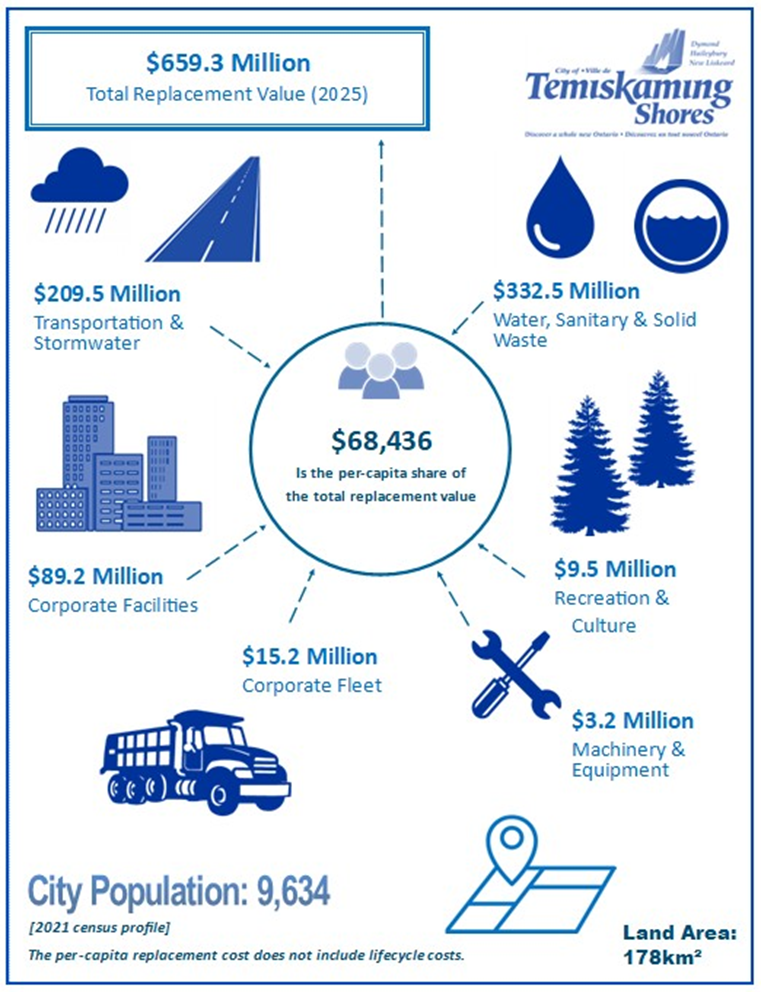
The total replacement value of all assets reported in the Asset Management Plan is estimated at $659.3 million.
State of Infrastructure
Using a 5-point rating scale, condition ratings are assigned to assets across all service categories, usually ranging from “0” (very poor) to “5” (excellent). Ratings are based on a combination of actual inspections, studies, and age-based data where detailed condition information is not available. These ratings are then converted into letter grades.
The overall grade value of all assets reported in the Asset Management Plan is estimated at B-.
| Service Category | Share of Overall Cost | Average Age (Years) | Condition Grade |
|---|---|---|---|
| Water | 26% | 43 | C+ |
| Sanitary | 21% | 44 | C+ |
| Stormwater | 16.1% | 42 | C- |
| Transportation | 17.5% | 41 | C |
| Solid Waste | 0.6% | - | B |
| Corporate Facilities | 14.3% | 42 | B |
| Recreation & Culture | 1.5% | 24 | B- |
| Corporate Fleet | 2.4% | 7 | B- |
| Machinery & Equipment | 0.6% | - | B |
Calculating Risk
The City uses a risk rating methodology to assign a risk score to each asset included in the Asset Management Plan. Risk ratings are based on two primary factors:
- Probability of failure (condition score)
- Consequence of failure
Asset condition helps determine the likelihood that an asset will fail, while consequence of failure measures the impact that failure would have on service delivery and the community. Additional information such as pipe size and material for linear infrastructure, and service type and replacement value for non-linear assets, is also considered in the evaluation process.
The City currently owns an estimated $22.3 million worth of high-risk assets.
Levels of Service and Financing
Asset management planning establishes short- and long-term strategic goals for municipal assets and infrastructure networks to best serve the public into the future. To support these goals, the Asset Management Plan integrates current and past assessments with future financial, operational, and capital planning.
The City’s goal is to move away from reactive responses and toward proactive, planning-based strategies. This includes evaluating all levels of asset maturity when considering maintenance, repair, and replacement needs, while also considering public expectations and long-term service sustainability.
Forecasted levels of service and proposed improvements are influenced by factors such as uncertainty in timing, cost escalation, and the availability of external funding. These challenges must be balanced against cost and risk trade-offs to maintain service levels and support long-term infrastructure sustainability. The City remains committed to continuously improving its Asset Management Plan through better data collection, stronger decision-making, and ongoing strategic review.
Contact Us
City of Temiskaming Shores
325 Farr Drive
P.O. Box 2050
Haileybury, ON P0J 1K0
Phone: 705-672-3363
Fax: 705-672-3200
Sign up to our Newsletter
Stay up to date on the city's activities, events, programs and operations by subscribing to our eNewsletters.